Blog · Day 3
The illusion of stock market gains: exploring alternative assets like Bitcoin and Class B/C multifamily real estate
InteractiveBitcoin vs. S&P 500 vs. gold ↓Ask most physicians how their retirement accounts have done and the answer is some version of "fine." The S&P 500 went up, and so did we. Over the last decade that is true in dollars: the index, with dividends reinvested, roughly quadrupled. The question I keep coming back to is what those dollars are being measured against.
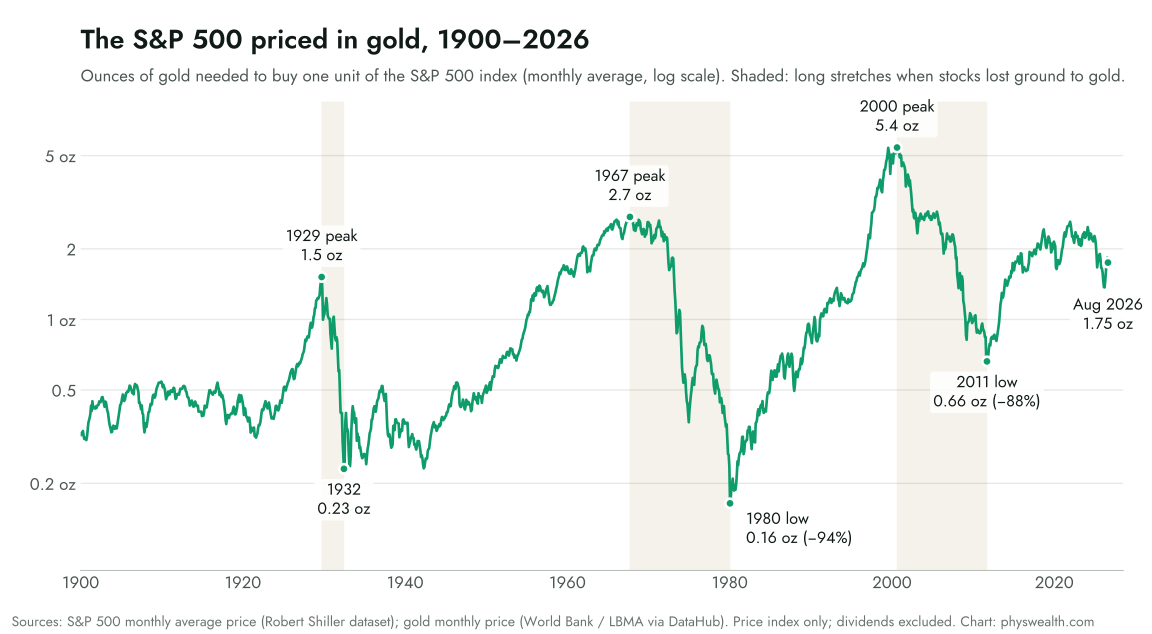
A dollar is a unit of account, not a fixed yardstick. Over those same ten years it lost about 28% of its purchasing power. Swap the yardstick for something no central bank can print more of and the picture changes. Measured in ounces of gold, the S&P 500 is up only about 27% since September 2016. Over the past five years it is down about 22% in gold terms: stocks nearly doubled in dollars, and gold did better.
Measured in Bitcoin, the gap is far wider. Money put into the S&P 500 ten years ago would today buy about 3% as much Bitcoin as it could then. That result comes with a caveat that matters. Bitcoin got there through month-end drawdowns of more than 75%, and over the past twelve months it has fallen about 30% while the S&P 500 gained about 17%. The yardstick is revealing. It is not smooth.
None of this means stocks are a bad investment. It means nominal gains overstate how much wealth was actually created, and that a portfolio built only on dollar-denominated assets is making a quiet bet on the dollar. Rather than ask you to take my word, or a chart on social media, for it, I built the tool below on monthly market data going back to 2010. Pick a period, switch between dollars, inflation-adjusted dollars and gold, and hover over any month.
This interactive tool needs JavaScript turned on.
A few things stand out once you use it. Start the clock in 2011, when gold peaked, and stocks beat gold comfortably. Start it in 2021 and gold wins. The starting point drives the conclusion, which is exactly why no single chart should. What never changes is the direction of the cash line: in real terms, it only goes down.
Bitcoin: the ultimate digital property and sound money
Bitcoin stands out as a prime example of an alternative asset that outperforms in this context. Often dubbed "digital gold," Bitcoin is designed with a fixed supply of 21 million coins, making it inherently deflationary and resistant to the inflationary pressures that plague fiat currencies. Since its inception in 2009, Bitcoin has achieved annualized returns exceeding 200% in many periods, far surpassing the S&P 500's average of around 10–11% annually.
What makes Bitcoin potentially the best digital property in human history? Its role as sound money. Unlike central bank-issued currencies, which can be printed at will—leading to debasement as seen in the post-1971 era after the U.S. abandoned the gold standard—Bitcoin operates on a decentralized network secured by proof-of-work. This scarcity mimics gold's properties but adds advantages like portability, divisibility, and verifiability in the digital age.
In 2025, with U.S. national debt exceeding $35 trillion and ongoing monetary expansion, institutional adoption has surged. Bitcoin ETFs have attracted over $50 billion in inflows since their approval, and companies like MicroStrategy have made it a core treasury asset, reporting billions in fair value appreciation. As the tool shows over most multi-year periods, holding Bitcoin has not only preserved but multiplied value relative to stocks, positioning it as a hedge against systemic financial risks.
Class B/C multifamily real estate: a tangible hedge against inflation
While Bitcoin represents the digital frontier, Class B and C multifamily real estate offers a more traditional, tangible alternative for investors seeking stability amid economic uncertainty. These properties—typically 20- to 40-year-old apartment buildings in working-class neighborhoods—provide steady cash flow through rentals and appreciate in value over time, often outpacing inflation.
In 2025, the multifamily sector is showing signs of recovery after a period of elevated supply. Vacancy rates for B- and C-class properties stand at around 5%, lower than the 7.8% for luxury Class A apartments. Effective rents are rising, with projections for positive growth below long-term averages, while new completions are expected to decline toward historical norms due to higher interest rates and tighter lending. Cap rates for C-class properties hover around 6.71%, offering attractive yields for income-focused investors.
Why do these assets shine? They benefit from inflation through rent adjustments—landlords can increase rents to match rising costs, maintaining real returns. Post-2020 housing shortages, fueled by underbuilding and population shifts, have pushed occupancy to 95% in many markets. Value-add opportunities, such as unit renovations, can boost net operating income by 20–30%, enhancing overall performance.
Moreover, real estate allows for leverage, where investors use debt to amplify returns, and tax benefits like 1031 exchanges enable deferred capital gains. In an inflationary environment, where nominal stock gains mask eroding purchasing power, Class B/C multifamily properties provide reliable income and capital preservation. As the Federal Reserve cuts rates in 2024–2025, borrowing costs are decreasing, making acquisitions more appealing.
Conclusion: diversifying beyond the stock illusion
Measuring the S&P 500 in something other than dollars is a wake-up call: nominal gains in stocks can be misleading when viewed through the lens of sound money alternatives. Bitcoin, with its unparalleled scarcity and adoption trajectory, exemplifies digital property that thrives in debased fiat systems. Meanwhile, Class B/C multifamily real estate offers grounded, income-generating protection against inflation.
As we navigate 2025's economic landscape—with stabilizing multifamily markets and continued Bitcoin institutionalization—investors would do well to diversify into these assets. While stocks remain a cornerstone, true wealth building may lie in what preserves value, not just what appears to grow on paper.
Questions and comments from physicians
Following publication, several readers raised thoughtful objections. Below is a Q&A addressing the most common ones, drawing on historical data, expert insights, and economic principles.
Bitcoin is too young to compare fairly to the S&P 500, which draws on the NYSE's 233-year history, or gold, which has been a store of value for millennia. Isn't this apples to oranges?
It's true that Bitcoin, launched in 2009, lacks the centuries-long track record of the NYSE (founded in 1792) or gold's ancient role as money dating back over 5,000 years. However, the comparison in the tool above isn't about longevity but about performance as a store of value in the modern fiat era, particularly post-1971 when the U.S. dollar detached from gold. Bitcoin's youth is actually a strength: in just 16 years, it has achieved a market cap over $1 trillion and outperformed both stocks and gold in real terms during periods of aggressive money printing. The S&P 500's long history includes devastating drawdowns—like the 57% drop in 2008–2009 or the 87% crash in 1929–1932—showing that age doesn't guarantee stability. Gold has endured, but its returns have been flat relative to stocks in nominal terms over decades. Bitcoin's fixed supply and decentralized network address flaws in both, making it a valid benchmark for today's digital economy. Over time, as adoption grows (nation-states like El Salvador holding it as reserves, for example), its "youth" may prove an advantage in adaptability.
Gold is expensive to store and bulky. Isn't the S&P 500 still better for ease of access? What about vaulted bullion, and why might Bitcoin beat gold in the long run?
Gold's physical nature does pose challenges: it's bulky for large holdings, vulnerable to theft if stored at home, and incurs ongoing costs. Professional vault storage—allocated or vaulted bullion in secure depositories—typically costs around 0.5% of the asset's value annually, with minimum fees starting as low as $9.99 per month for smaller amounts. These options provide insured, segregated storage in facilities like those in Zurich or Singapore. ETFs like GLD allow indirect exposure without physical handling, though they introduce counterparty risk.
That said, the S&P 500's ease (low-cost index funds, no storage fees) doesn't make it inherently better, as the article highlights how nominal gains erode against inflation and debasement. Gold has preserved value over millennia, but Bitcoin could surpass it long-term due to superior properties: it's digital and weightless, infinitely divisible, transferable globally in seconds without intermediaries, and verifiable on a blockchain. Unlike gold, which can be confiscated or diluted by new mining, Bitcoin's 21 million cap is immutable. As digital economies dominate, Bitcoin's portability and resistance to censorship position it as "digital gold" upgraded for the 21st century, potentially capturing gold's $15 trillion market while avoiding its logistical drawbacks.
If you had invested in the S&P 500 the day before the 2008 crash, you'd still have strong returns today. Doesn't that show stocks are resilient regardless?
This argument relies on hindsight and perfect timing, which is rarely achievable for most investors. If you invested in the S&P 500 at its peak on October 9, 2007, the index fell 57% to its March 2009 low, and it took until 2013 to recover to pre-crash levels nominally—not accounting for dividends or inflation. By February 2024, that investment would have grown about 350% in total including reinvested dividends, which sounds impressive. However, this ignores opportunity costs: during the recovery, gold rose over 300% from 2007 to 2011, and Bitcoin (from 2010 onward) delivered exponential gains.
The real issue is that no one can consistently time the market—missing the best days (often right after crashes) can halve long-term returns. For non-traders, who make up most investors, long-term holding is key, but even then the S&P's average annual return of about 10% nominal since 1926 drops to about 7% after inflation. Volatility in short-term windows (intra-year drops averaging 15% over the past 20 years) can lead to emotional selling at lows. Alternatives like Bitcoin or real estate emphasize real, inflation-adjusted preservation over decades, not short-term spikes. Dollar-cost averaging into diversified assets mitigates timing risks better than betting solely on stocks' resilience.
Bitcoin has no utility—it's slow, expensive to transact, and energy-hungry. Other cryptos are as secure but faster. How do you refute this?
Bitcoin's critics often focus on its transactional limitations—high fees during peaks, roughly seven transactions per second, and energy consumption equivalent to a small country—but this misses its core purpose as a store of value, not a payment rail. Drawing on Michael Saylor's framing, Bitcoin isn't competing as "digital cash" for coffee purchases; it's "digital property" or "digital energy," the apex monetary asset due to its unmatched decentralization, security, and network effects. Other cryptos (Ethereum for smart contracts, Solana for speed) are more like securities or tech platforms, vulnerable to centralization, regulatory scrutiny, or founder control. Bitcoin's energy use isn't waste—it's the proof-of-work mechanism that secures the network against attacks, making it the most battle-tested blockchain with over 99.99% uptime since inception.
Its "slowness" is intentional for security; layers like the Lightning Network enable fast, cheap micropayments off-chain. Persistence comes from first-mover advantage: a $1.5 trillion market cap, institutional adoption (ETFs, corporate treasuries), and immutability that no altcoin matches. In a world of infinite fiat, Bitcoin's utility is being the hardest money ever created. For more, see Michael Saylor on X.
You mention Class B/C multifamily as an alternative, but you don't graph its return against the S&P. Why not?
Graphing returns for Class B/C multifamily real estate against the S&P 500 isn't straightforward due to the asset class's inherent diversity and structure. There are hundreds of ways to invest in real estate—direct ownership, REITs, syndications, funds—each with unique factors like location, management quality, leverage, and market conditions influencing performance. Unlike the S&P 500, a standardized index with publicly available historical data, real estate deals are often private and heterogeneous, making apples-to-apples comparisons difficult.
Additionally, SEC rules restrict how syndicators and funds can advertise or compare performance. Regulation D limits general solicitation of past returns in a way that could be seen as promoting specific investments, and each deal must be evaluated independently on its merits, risks, and projections rather than historical aggregates. Aggregated indices like the NCREIF Property Index show average annual multifamily returns of around 7–10% over long periods (income and appreciation), which can compete with or exceed the S&P's inflation-adjusted returns—but these are broad averages, not reflective of individual Class B/C deals.
Hold periods for many syndications are typically five years or less, focused on value-add strategies and exits via sale or refinance, which doesn't lend itself to multi-decade charting. Plotting them could mislead by implying a consistency that isn't there. The practical answer is due diligence on specific opportunities over broad benchmarks, with attention to total-return metrics like IRR—which well-managed Class B/C deals often target at 15–20% annually, though again, these are deal-specific.
See all of the free physician calculators →
Educational content only, not personalized financial, tax or investment advice. Figures cited are as of the date of writing and may have changed.
Talk to me before you invest
Physicians should be able to ask the sponsor direct questions and get direct answers. That is how I would want to be treated, and it is how we run The Laager Group.
Review the current offering
Projections, assumptions, property details and offering documents for the Cincinnati Portfolio.
invest.laagergroup.comSchedule a conversation
Reach the Laager team directly. Principals are available to prospective investors as part of diligence.
Contact The Laager GroupExisting investors
Reports, documents, distributions and tax materials in the investor portal.
Investor login