You committed your life to public health. Don't let CMS control your financial health.
InteractiveIncome outside the fee schedule ↓Every year, a federal agency decides what a unit of my work is worth. It doesn't ask how long the case took, what my staff cost, or what my malpractice premium did. It publishes a number, the conversion factor, and every procedure I do and every patient I see is multiplied by it.
In 2001 that number was $38.26. For 2027, CMS has proposed $32.84. Over the same stretch, the American Medical Association says the cost of running a medical practice rose 59%, and that Medicare physician pay, adjusted for those costs, fell 33% from 2001 to 2025.
Percentages are abstract, so here is the same thing in groceries. Pick a cup of coffee, a gallon of gas or a dozen eggs, and see how many of them Medicare's payment for the same amount of work buys each year.
This interactive tool needs JavaScript turned on.
We spend our careers protecting other people's health. Most of us have handed control of our own financial health to a fee schedule. It doesn't have to stay that way.
Why working harder won't fix it
The instinct is to see more patients, take more call, add another block. The 2026 and 2027 rules show why that is a treadmill:
- Efficiency is treated as a reason to pay less. On January 1, 2026, CMS cut the work value of roughly 7,700 procedure codes by 2.5%, using an economy-wide productivity figure rather than a measurement of how long procedures actually take. It plans to repeat the adjustment about every three years. As a vascular surgeon, nearly every procedure I bill took that cut.
- The 2027 proposal cuts again. The conversion factor drops 1.68% for most physicians (1.19% for qualifying APM participants) as a temporary 2026 increase expires.
- Same-day care gets halved. CMS has proposed paying 50% for a separately identifiable office visit billed on the same day as most procedures. The AMA has asked CMS to withdraw it.
- More risk is coming. A mandatory Ambulatory Specialty Model starts in 2027 for heart-failure and low-back-pain specialists in selected markets, with payment adjustments of up to 9% in either direction, and remote-monitoring payments face cuts of up to 19% a year.
You can be more efficient, more productive and better at your job, and the system is built to capture that gain rather than pass it to you.
Every way out is a trade
Physicians have not taken this sitting down. Most of us have chosen one of a handful of responses, and each is a trade:
- Join a hospital or an integrated system. Many colleagues joined a hospital, or a system like Kaiser Permanente, because the dollars per work RVU on offer were higher than an independent practice could pay itself. By January 2026, 82% of U.S. physicians were employed by hospitals or corporate entities, and 253,000 physicians moved into employment between 2018 and 2026, according to the Physicians Advocacy Institute. The trade is autonomy: over your schedule, your staff and often your clinical decisions, and you answer to administrators who are not physicians.
- Sell to private equity. Some of us sold our practices to private-equity-backed groups. It can bring capital, scale and liquidity, and it brings a new set of owners with their own targets and timelines.
- Stay independent and adapt. Others keep finding ways to survive under CMS's rules: new service lines, tighter operations, better coding, more volume. It works until the next rule changes the math.
- Leave Medicare's pricing altogether. Some opt out of Medicare and contract privately with patients, or move to a concierge or direct-care model funded by membership fees. It restores control over price, and it narrows the patients you can see and the referrals you receive.
None of these escapes the fee schedule completely. When the conversion factor falls, a hospital's or a private-equity group's revenue per work RVU falls with it, and that shows up at your next contract renewal. Commercial contracts are often negotiated as a multiple of Medicare rates, so even practices that see few Medicare patients feel it.
Whatever path you are on, and whatever situation you find yourself in, the same thing is true: you don't have to be powerless over the money you earn.
An honest footnote: the office visit
You will hear that Medicare pays less for an office visit than it did decades ago. That isn't quite right, and I would rather you hear it from me. In 1976 and 1977, federal surveys put Medicare's average payment for a routine follow-up office visit at $9.70 for primary care physicians, about $53 in today's dollars. In 2026, Medicare pays $95.19 for a comparable follow-up visit (99213) and $117.57 for a new-patient visit (99203). Office visits were revalued upward in 1992 and again in 2021.
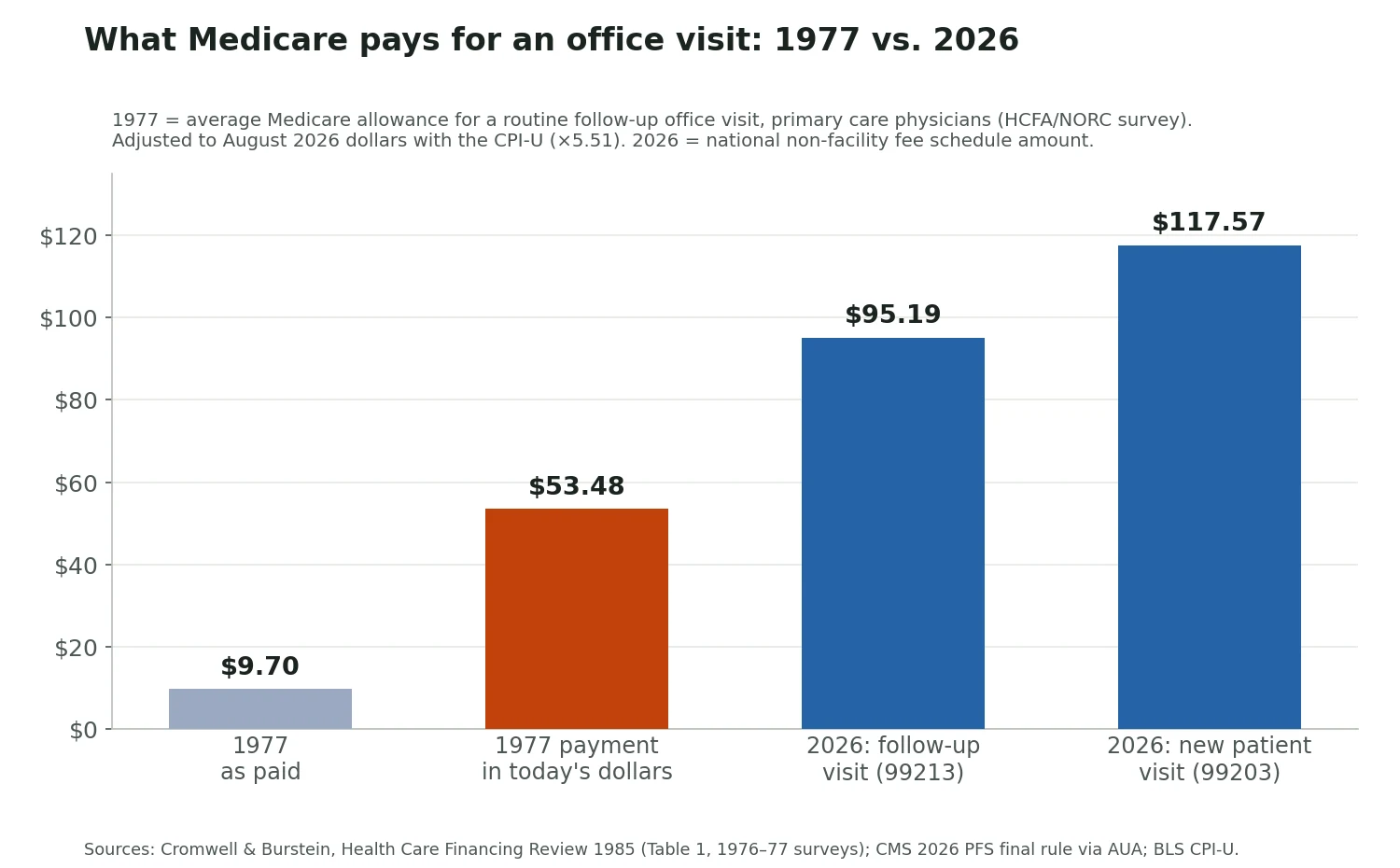
The squeeze is real, but it is in the conversion factor, in procedures, and in what it costs to keep a practice running. That is the part no amount of extra work will fix.
Build an engine CMS can't touch
The answer I have come to for my own money is to take a portion of clinical income every year and put it into assets whose value isn't set by a fee schedule. Over time, more of your financial life runs on that engine and less of it depends on a number published every November. For me, the engine has three parts.
1. Multifamily real estate, as a limited partner: rent paid by tenants, not by a payer
An apartment community's income comes from hundreds of leases that reset every year, not from a government formula. Depreciation can shelter much of the cash it pays out, and as a limited partner in a syndication you contribute capital and judgment, not your evenings. It has real risks: debt, local markets, the sponsor and years of illiquidity. I explain the tax side in real estate tax concepts for physicians and the questions I ask any sponsor in how physicians evaluate a multifamily syndication. A disclosure: I am a Director of The Laager Group, which sponsors multifamily syndications, and I invest in its deals.
2. Bitcoin: a fixed supply no one reprices
Bitcoin's supply is capped at 21 million coins by its code. No central bank can print more and no payer sets its price; the market does. Since 2024 it has been available through spot ETFs in an ordinary brokerage account or IRA. It also produces no income, and it is brutally volatile: measured on monthly closing prices, it has fallen 82%, 81%, 76% and 73% from prior peaks since 2011, and about 49% from July 2025 to June 2026. Size it so that a 75% drop would not change your life. My Bitcoin vs. S&P 500 vs. gold chart shows every month since 2010.
3. The structure: keep more of what the engine earns
How you hold these matters as much as what you hold. Real estate's depreciation is most valuable in a taxable account. If you have locums, call-contract or consulting income, a side LLC can sponsor a Solo 401(k) next to your employer's plan; I walk through it in a side LLC and a Solo 401(k) for W-2 physicians.
How big does the engine need to be?
Set your clinical income, how fast you think its purchasing power erodes, and how much you invest each year. For the multifamily piece, the calculator starts from the historical average of the past deals I invested in: a 20.4% realized IRR across seven deals completed by Laager principals in prior entities (details under the buttons). For Bitcoin it assumes 15% a year. This is a hypothetical illustration only, and past performance cannot be relied on to predict future results. Switch to Cautious to see how much the answer depends on those assumptions; every one of them is yours to change.
This interactive tool needs JavaScript turned on.
What this is, and what it isn't
This is how I think about my own money, not a recommendation for yours. Before you act, talk to your own CPA, an attorney and a fiduciary financial adviser who is paid by you. Past performance does not predict future results, and every investment here can lose money.
The fee schedule is CMS's document. Your financial health is yours. You committed your life to public health; don't let CMS control your financial health.
Sources: AMA conversion factor history and Medicare payment analyses; CMS CY 2026 final and CY 2027 proposed physician fee schedule rules; Holland & Knight and AHA summaries of the 2027 proposed rule; Becker's ASC Review; Physicians Practice; Physicians Advocacy Institute and Avalere Health, physician employment trends 2018 to 2026; Cromwell and Burstein, Health Care Financing Review (1985); Bureau of Labor Statistics CPI-U. Bitcoin drawdowns are calculated from monthly closing prices. Figures are as of October 16, 2026.
Next step
Ready to take the next step toward independent wealth outside of medicine?
Practice medicine on your own terms.
The current offering is sponsored by The Laager Group, is open to accredited investors only, and is made only through its offering documents. This article is not an offer to sell or a solicitation of an offer to buy any security.
See all of the free physician calculators →
Educational content only, not personalized financial, tax or investment advice. Figures cited are as of the date of writing and may have changed.
Talk to me before you invest
Physicians should be able to ask the sponsor direct questions and get direct answers. That is how I would want to be treated, and it is how we run The Laager Group.
Review the current offering
Projections, assumptions, property details and offering documents for the Cincinnati Portfolio.
laagergroup.comSchedule a conversation
Reach the Laager team directly. Principals are available to prospective investors as part of diligence.
Contact The Laager GroupExisting investors
Reports, documents, distributions and tax materials in the investor portal.
Investor login